
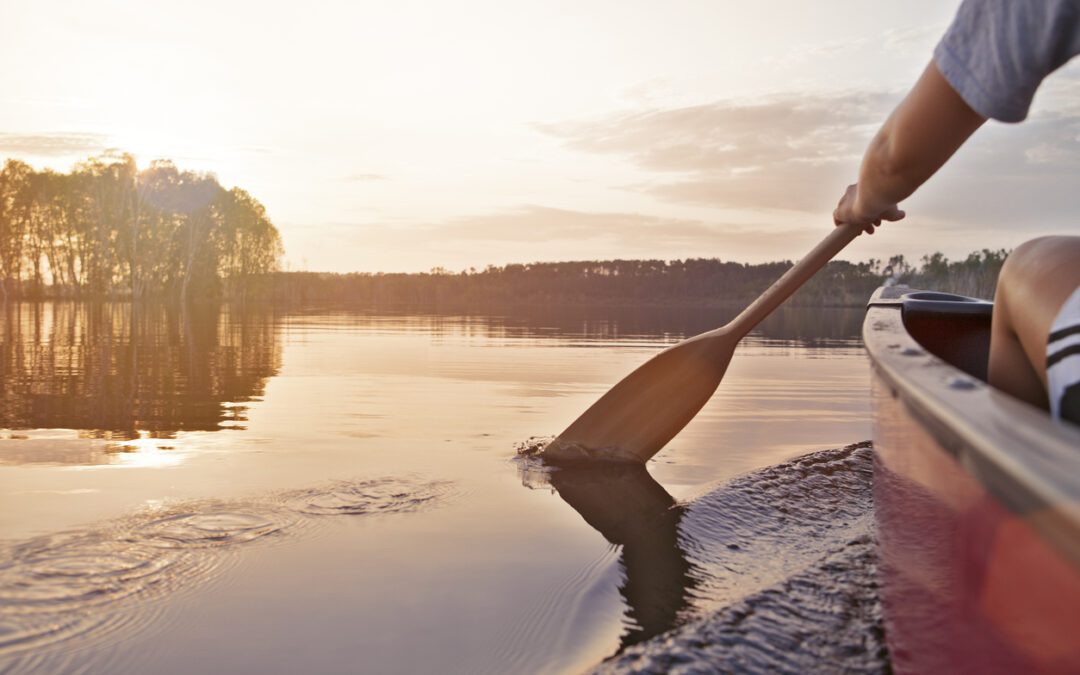
Oscoda natives credit local upbringing for participation in Canoe Marathon
Oscoda is home to many things — beautiful beaches, unique mom-and-pop shops, impressive fireworks and festivals, gorgeous lakeshore and riverside views; but it also hosts the finish line for one of the most physically demanding races in the world.
The AuSable River Canoe Marathon stretches 120 miles from Grayling to Oscoda, wrapping up just across the street from the AuSable Inn at Finish Line Park. The marathon has been ongoing for seven decades.
“It’s considered the most prestigious canoe race in the world,” Justin Griffith, a longtime committee member, told Under the Radar in 2025. “There are tougher ones, there are longer ones … but this is the one that everybody wants to do.”
There were 114 two-person teams on the starting line in 2025, a record for a race that began as the brainchild of Howard Brubaker and Frank Davis in the 1940s. The two men, who sought to draw more tourists to Oscoda after Labor Day, spent 31 hours completing a test run before launching the official event in September 1947 — and it took them a week to recuperate.
So, what’s the race like for canoers in 2026? It doesn’t take 31 hours; but it’s grueling and invigorating all the same. To get a clearer picture, we spoke with Caleb Watson and Logan Lammi, natives and recent participants. Their answers have been edited for length and clarity.
What made you decide to participate in canoe races? How many have you done and where?
Caleb: I grew up in Oscoda with my father showing me the finish line. I also have family who live on the AuSable and decided to try it. (This) will be my fourth year racing.
Logan: I’ve participated in approximately 20 canoe races over the past three years, including one AuSable River Canoe Marathon and the rest events by the Michigan Canoe Racing Association. Those circuit races happen all over the state, from Tahquamenon Falls to Ann Arbor and from Oscoda to Traverse City.
Can you describe the physical feat? It’s hard not to outright ask how you do it; but really, how?
Caleb: The physical feat turns into more of a mental feat. You know, on the starting line, your back will be aching, arms will be noodles, your butt is going to be sore. Staying mentally strong enough is what will get you to the finish line.
Logan: I would consider finishing the AuSable River Canoe Marathon more of a mental feat than physical. The training that starts in January (for most racers) and never stops for others prepares your body physically. The hardest part is pushing through, when all you want to do is stop paddling.
What happens after racers reach the finish line? How many days does it take to recover?
Caleb: My first priority when finishing the race is to hug my mom and family; the ones who followed me and fed me. (Racers coordinate with a feed team of 2-4 people who follow along the route to provide bottles of water, food, additional paddles, medicine and repair supplies.) Typically it’s at least a week before (my) body feels fine. My first year, I couldn’t even open a doorknob or a water bottle until Monday.
Logan: Most racers are swarmed by loved ones and their feeding crew upon reaching the finish line. Overwhelmed with happiness to have completed the race, many go for a cold beverage of their choice, whether that be a beer, chocolate milk or Coca-Cola. I think most people recover pretty quickly and are paddling again within two weeks. I was paddling again four days after finishing the race last year.
What’s the best part of participating in the race? What’s the biggest challenge?
Caleb: The best part about the local race is being supported by the entire community. There’s people that I’ve never talked to, but are also from Oscoda, who cheer me on. The biggest challenge is finding people to training with, as many paddlers live downstate or in Grayling. I’ve even raced with somebody from Quebec.
Logan: The best part of participating is the support from the community along the way. I would say the biggest challenge is the amount of time it takes to train to be at a competitive level and go for more than just finishing.
What’s something most people might not realize about canoe racing?
Caleb: Most people don’t see the hours of training, waking up at 4:30 a.m. to do a seven-hour practice run on a Saturday. (It’s also) sacrificing the summer and (spending) less time with friends or typical hobbies to ensure you get enough training in.
Logan: Most people don’t realize how calculated the feeding plan is throughout an endurance event like the AuSable River Canoe Marathon. How many milligrams of sodium, how many calories per hour, what type of sugar your body needs for fuel are all very precise things. Also, the dedication of the feeding/pit crews that follow teams through the night to make sure they get everything they need.
Racers leave the water several times to bypass dams (known as a portage). Is that particularly challenging, or does it provide a break?
Caleb: The portages at the dams are a love/hate relationship. You get the break outside of the canoe and get to stretch out your legs for just a sliver of time; although it comes with the stress of ensuring you get (your food) and anything extra you might think of. Communication with the feeders is extremely difficult since we don’t have phones, so we have to let them know at the prior feed location if we want something that’s not on the plan.
Logan: For some teams, the portage can be daunting. A lot of older competitors can paddle a lot faster than they can run. For a young team like mine, the portages are a nice chance to stretch the legs and make up ground on other teams that don’t run as well.
Speaking of breaks, do you ever get to rest during the race? How do you eat? What do you eat?
Caleb: There’s no real “break,” only the small times where our feed teams will give us new drink bottles and small bits of solid food. Most racers rely on a brand of liquid food called “Spiz.” It’s basically all carbs and tastes horrible. Racers drink through bottles with a hose attached, so you don’t have to stop paddling to eat. Some racers mix electrolytes in … and others keep them separate. I primarily rely on liquid food, as it’s easier on the stomach during the intense exercise.
Logan: There’s no breaks! We have mostly a liquid diet consisting of one liter per hour. I use two different drink mixes, one being similar to Gatorade for liquid carbs and sugar; the other is an all-around meal replacement containing protein and tons of vitamins. The body processes liquid easier than solids while working at a high level.
What’s your connection to Oscoda? Is there anything that makes the region particularly special to you?
Caleb: I was born and raised in Osocda. My father always took me fishing when I was young, and that turned into me loving any activity that involved the woods or water.
Logan: My connection is being born here. Most of my family and friends live in the area. The AuSable River and Iosco County are special to me because of the nature and people that it holds.
Information for this article was gathered from Justin Griffith, Logan Lammi, Caleb Watson and the official website for the AuSable River Canoe Marathon.